By The Low Interest
14 Aug, 2026
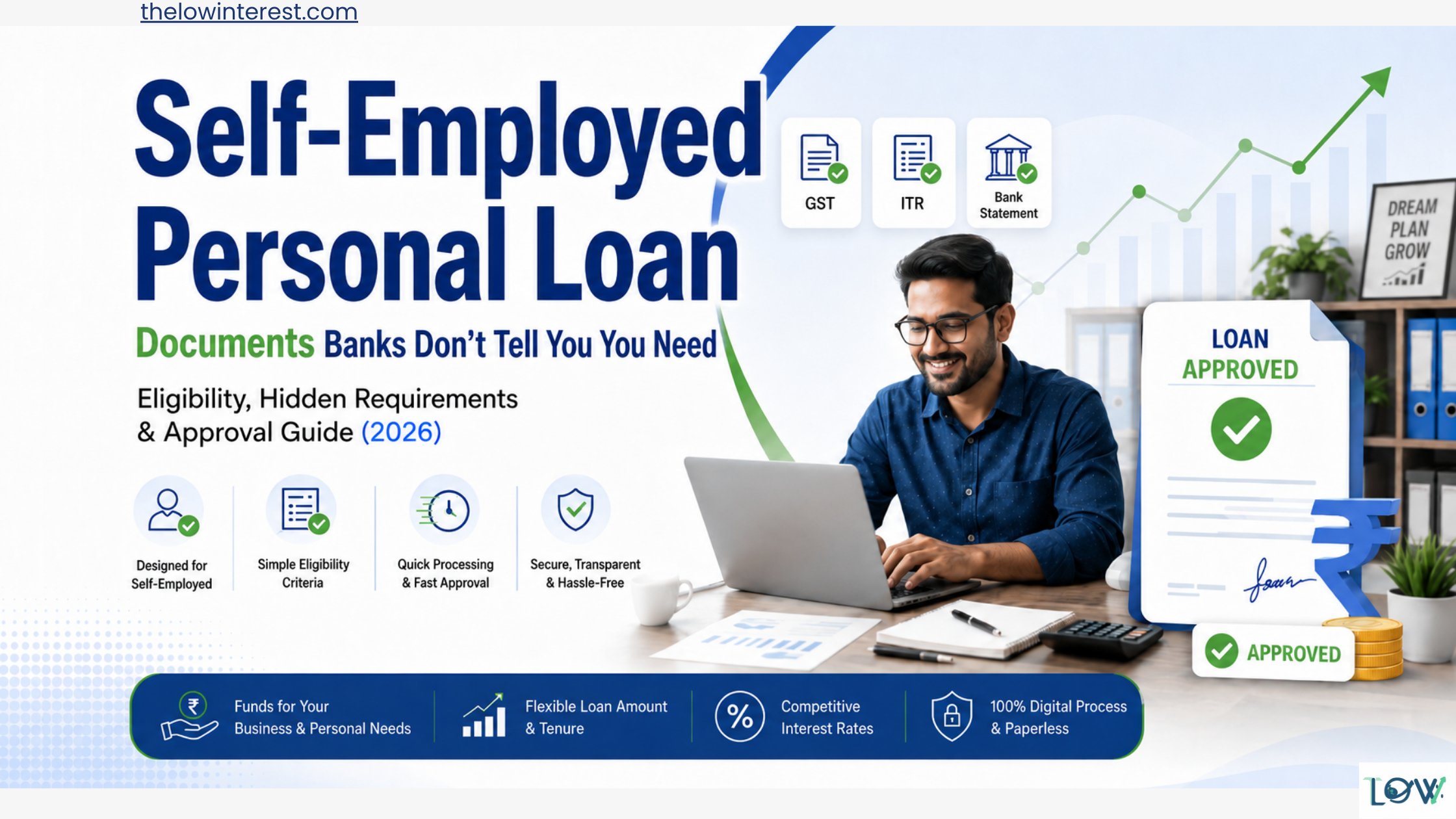
Self-Employed Personal Loan Documents Banks Don’t Tell You
Key takeaways:
-ITR and GST returns replace the salary slip as your core income proof.
- 2-3 years of business vintage and a 650+ CIBIL score are the practical minimums.
- Consistency across all your financial documents matters more than any single one.
- NBFCs often offer more flexibility than traditional banks for this borrower profile.
If You Are A Self Employed Get a Personal Loan fast
Running your own business or working as an independent professional shouldn’t make borrowing harder — but many self-employed applicants find lenders asking questions salaried employees never face. Understanding what’s actually required removes most of that friction.
A personal loan for self-employed individuals is evaluated using business income proof — ITR filings, GST returns, and bank statements — instead of a salary certificate. This guide covers eligibility criteria, the documents that matter most, and a practical path to approval.
Who Qualifies as Self-Employed for Loan Purposes?
Lenders generally place self-employed applicants into two categories:
Self-employed professionals — doctors, chartered accountants, architects, consultants, and similar qualified professionals.
Self-employed non-professionals — traders, shopkeepers, manufacturers, and other business owners.
Each category has slightly different documentation expectations, though the core eligibility principles overlap significantly.
Core Eligibility Criteria For Personal Loan For Self-Employed
Most lenders apply broadly similar baseline requirements:
1. Minimum business/professional vintage of 2-3 years, showing operational stability.
2. Minimum annual income, typically starting around ₹2-3 lakh depending on the lender.
3. CIBIL score of 650+, with 750+ needed for the most competitive rates.
4. Consistent bank account activity reflecting genuine business inflows.
Documents You’ll Need for loan For Personal Loan For Self-Employed
1. Income Tax Returns (Last 2-3 Years)
ITR is the backbone of a self-employed loan application. Lenders use your declared income to calculate eligible loan amounts, similar to how salaried applicants are assessed on CTC.
2. GST Returns (If Registered)
For business owners with GST registration, filed returns demonstrate turnover and business continuity — particularly useful if your ITR alone doesn’t fully reflect your business scale.
3. Bank Statements (6-12 Months)
Statements from your primary business or professional account show real cash flow patterns, which lenders cross reference against your declared ITR income.
4. Business Registration Proof
Shop Act license, GST certificate, or professional registration (e.g., medical council registration for doctors) confirms the
legitimacy and continuity of your business.
Step-by-Step Loan Application Process
1. Check your CIBIL score and correct any errors before applying.
2. Gather ITR, GST returns, and bank statements for the last 2-3 years.
3. Estimate a realistic loan amount — typically capped at a multiple of your average annual declared income.
4. Compare NBFCs and banks specifically for self-employed loan products, since terms vary more here than for salaried loans.
5. Submit business registration proof alongside your personal KYC documents.
6. Be prepared for a slightly longer verification window, as self-employed income requires more manual cross checking than a payslip.
Common Reasons Self-Employed Applications Get Rejected
Inconsistent income across ITR, GST, and bank statements that don’t tell a coherent story.
Requesting a loan amount disproportionate to declared income or turnover.
Newly registered businesses without the minimum vintage most lenders require.
High existing EMI burden relative to declared income.
Frequently Asked Questions
Q.What documents are required for personal loan for self employed?
The core set includes 2-3 years of ITR, GST returns (if registered), 6-12 months of bank statements, and business or professional registration proof, alongside standard KYC documents.
Q.What is the minimum business vintage required?
Most lenders require 2-3 years of continuous business or professional operation, though some NBFCs consider shorter vintages with stronger income documentation.
Q.Can a self-employed person with a low CIBIL score get a loan?
Yes, though options narrow — a co-applicant, smaller loan amount, or NBFC with flexible underwriting can offset a lower score, similar to salaried applicants in the same position.
Q.Is the interest rate higher for self-employed personal loans?
It can be slightly higher due to added income verification complexity, though a strong CIBIL score and consistent financials can secure rates comparable to salaried applicants.
Q.Do freelancers count as self-employed for loan purposes?
Yes, freelancers are typically assessed as self-employed non-professionals, using ITR and bank statement patterns to demonstrate consistent income from multiple clients.
Q.How much loan amount can a self-employed applicant get?
Loan amounts are usually calculated as a multiple of average annual declared income from ITR, adjusted based on bank statement consistency and existing debt obligations.
Conclusion
A personal loan for self-employed applicants isn’t harder to get — it just requires a different, more complete documentation story built from ITR, GST returns, and bank statements working together. Presenting these consistently is what actually determines approval.
If you’re self-employed and ready to apply, gather your ITR, GST returns, and bank statements first — a well-documented application is the fastest route to approval.