By The Low Interest
13 Jul, 2026
Understanding Your Credit Score: A Complete Guide
By The Low Interest / Credit Score / July 2026
Your credit score plays a major role in getting approved for loans and credit cards in India. Whether you're applying for a personal loan, home loan, business loan, or a new credit card, lenders use this three-digit number to evaluate your repayment history and financial discipline.
This guide explains what a credit score is, how it's calculated, what affects it, and how you can improve it for better borrowing opportunities.
What Is a Credit Score?
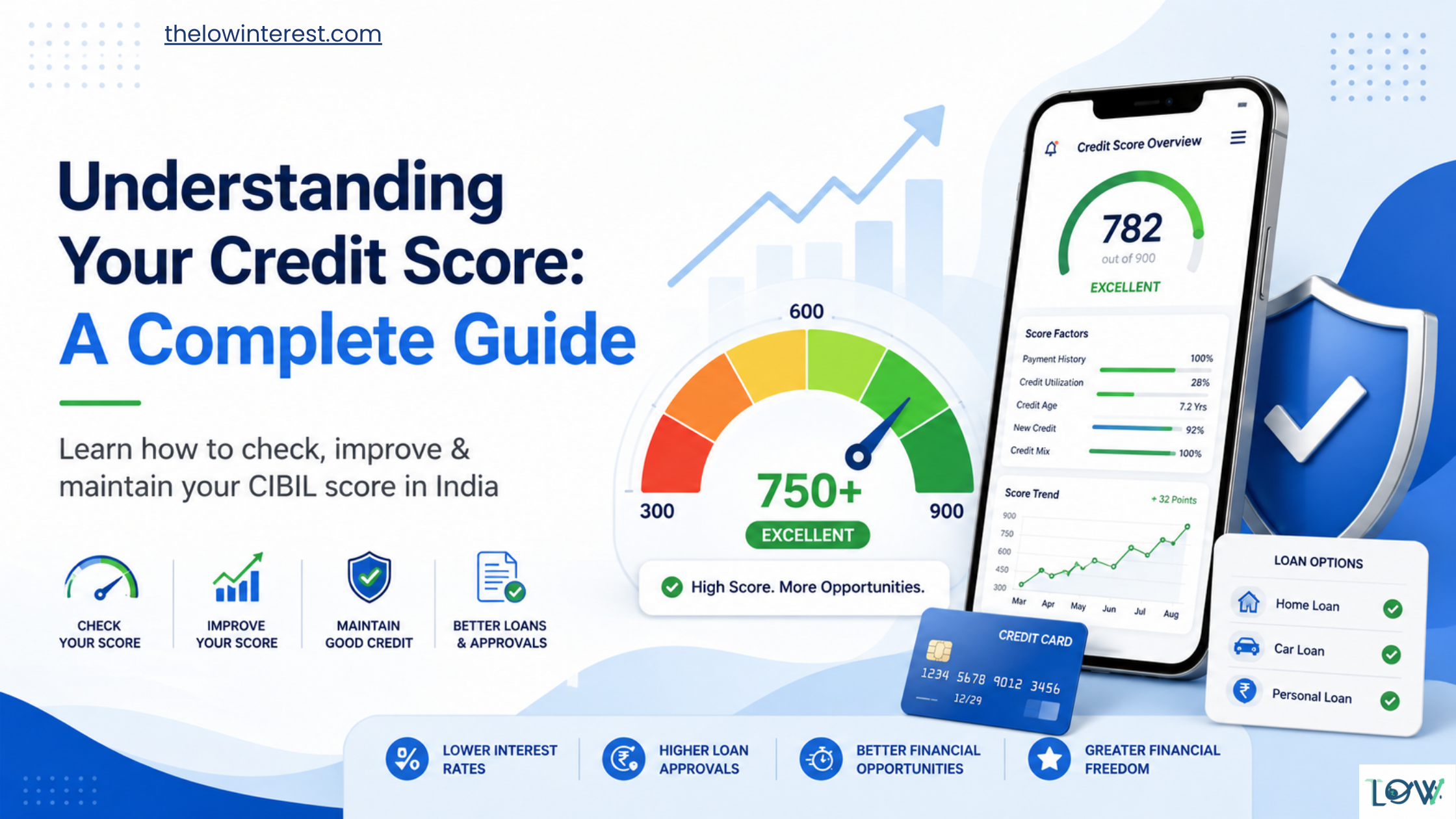
A credit score is a three-digit number, usually between 300 and 900, that shows lenders how reliably you repay debt. In India, it's calculated by credit bureaus like CIBIL using your payment history, credit utilization, credit mix, and loan enquiries. A score above 750 is considered good to excellent.
A higher score indicates responsible credit management and increases your chances of getting approved for loans at competitive interest rates.
Why Your Credit Score Matters
Your credit score is a numerical summary of your credit behavior, ranging from 300 to 900 in India, generated by bureaus such as CIBIL (TransUnion), Experian, Equifax, and CRIF High Mark. Lenders use it to decide whether to approve loans and credit cards, and at what interest rate. The score is built from five core factors: payment history (35%), credit utilization (30%), length of credit history (15%), credit mix (10%), and recent loan enquiries (10%). A score of 750 or above generally qualifies for the best rates, while scores below 650 often lead to rejection or higher interest. Checking your score monthly and paying on time are the fastest ways to improve it.
Your credit score influences:
Generally, borrowers with scores above 750 receive better offers from banks and NBFCs.
How Credit Scores Are Calculated
Although every bureau uses its own model, these factors have the biggest impact:
Factor | Approx. Weight |
Payment History | 35% |
Credit Utilization | 30% |
Length of Credit History | 15% |
Credit Mix | 10% |
Recent Credit Enquiries | 10% |
The most important factors are paying bills on time and keeping credit card usage low.
Credit Score Ranges
Score | Rating |
800–900 | Excellent |
750–799 | Very Good |
700–749 | Good |
650–699 | Fair |
Below 650 | Poor |
A score of 750+ is generally considered ideal for most loan applications.
Major Credit Bureaus in India
India has four RBI-authorized credit bureaus:
TransUnion CIBIL
Experian
Equifax
CRIF High Mark
Different lenders may use different bureaus, so scores can vary slightly.
Factors That Affect Your Credit Score
Payment History
Always pay EMIs and credit card bills before the due date.
Credit Utilization
Keep credit card usage below 30% of your total credit limit.
Credit History Length
Older, well-managed accounts strengthen your score.
Credit Mix
Maintaining both secured and unsecured loans helps create a balanced credit profile.
Loan Enquiries
Avoid applying for multiple loans within a short period, as frequent hard enquiries may reduce your score.
How to Check Your Credit Score
You can check your score through:
Checking your own score is a soft enquiry, so it does not affect your credit score.
Common Credit Score Myths
Myth: Checking my own score lowers it.
Fact: Self-checks never reduce your score.
Myth: Income determines credit score.
Fact: Repayment behaviour matters far more than salary.
Myth: Carrying credit card balances improves score.
Fact: Paying bills in full is healthier for your credit profile.
Myth: Closing old cards always improves credit.
Fact: Credit history may be shortened and increase utilization
How to Improve Your Credit Score
Follow these habits consistently:
Pay every EMI on time.
Keep utilization below 30%.
Avoid multiple loan applications.
Review your credit report regularly.
Correct reporting errors quickly.
Keep old credit accounts active.
Use credit responsibly.
Credit score improvement usually takes several months of disciplined financial behaviour.
Common Mistakes That Lower Your Score
Avoid these mistakes:
Missing EMI payments
Paying only minimum credit card dues
Maxing out credit cards
Applying to several lenders together
Ignoring errors in your credit report
Defaulting on co-signed loans
Credit Score Checklist
Before applying for a loan:
✔ Check your latest credit score
✔ Pay all outstanding dues
✔ Keep utilization below 30%
✔ Review your credit report
✔ Avoid unnecessary loan enquiries
✔ Maintain older accounts
Real-Life Examples
Example 1:
A salaried employee with multiple recent loan enquiries faced rejection despite having a good score. Waiting a few months before reapplying improved approval chances.
Example 2:
A business owner reduced credit card utilization from 85% to below 30%, resulting in a noticeable improvement in credit score over time.
Example 3:
A first-time borrower built credit history using a secured credit card and later qualified for an unsecured card.
Credit Score vs Credit Report
Credit Score | Credit Report |
Three-digit rating | Complete borrowing history |
Quick risk indicator | Detailed financial record |
Used for instant decisions | Used for detailed review |
The report explains why your score is at its current level.
Key Takeaways
Credit scores range from 300–900.
A score above 750 improves loan approval chances.
Payment history and credit utilization have the biggest impact.
Checking your own score doesn't reduce it.
Responsible borrowing and timely repayments gradually improve your score.
FAQs
1. What is a good credit score in India?
A score of 750 or above is generally considered good to excellent by most Indian lenders
2. Is CIBIL the only credit bureau in India?
No. CIBIL is the most widely used, but Experian, Equifax, and CRIF High Mark are also RBI-licensed bureaus.
3. How often is my credit score updated?
Most bureaus update scores monthly, based on data reported by lenders.
4. Can I get a loan with a low credit score?
Yes, but often only with a co-applicant, collateral, or a higher interest rate.
5. How long does negative credit history stay on my report?
Most negative items remain visible for around 7 years, though their impact fades over time.
6. Does closing a credit card improve my score?
Not usually — it can shorten your credit history and raise your utilization ratio.
7. What is considered high credit utilization?
Anything above 30% of your total available limit is generally considered high.
8. Can I have no credit score at all?
Yes — this is called a "thin file," common for first-time borrowers with no credit history yet.
Conclusion
Your credit score reflects your financial habits and plays a key role in loan approvals and interest rates. By paying EMIs on time, keeping credit utilization low, and avoiding unnecessary loan applications, you can steadily build a stronger credit profile. Small, consistent improvements today can lead to better financial opportunities in the future.- Thelowinterest