By The Low Interest
12 Oct, 2026
Marriage Loan Eligibility: How Much Can You Borrow?
home > loans > personal loan > marriage loan
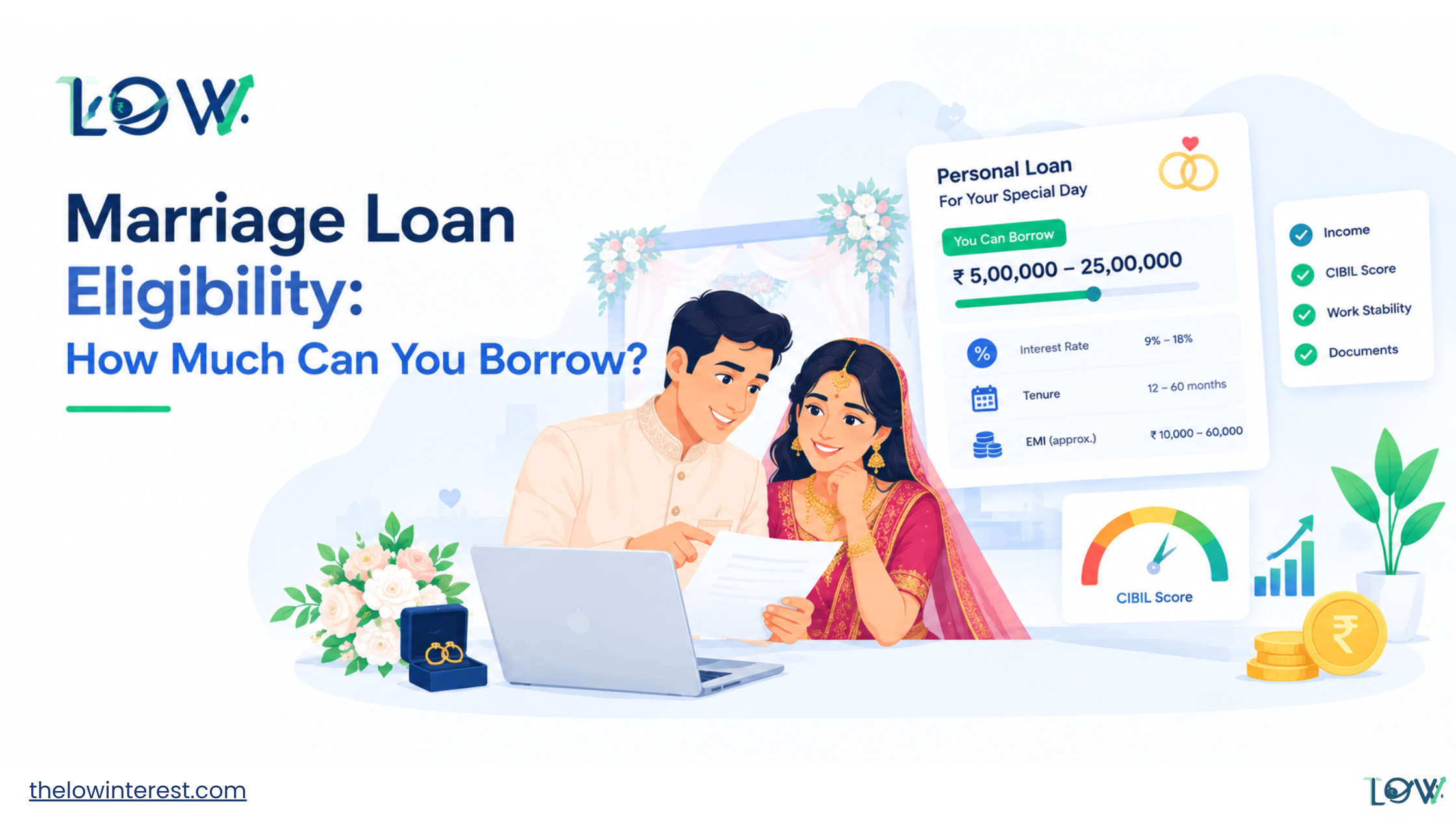
Marriage loan eligibility depends on your income, existing EMIs, credit score and age, not on your wedding budget. Most lenders approve an amount whose EMI keeps all your repayments within about 40–50% of take-home pay. At 12% a year over five years, a ₹30,000 EMI supports a marriage loan of around ₹13.5 lakh.
This guide shows what lenders check, how to calculate your own limit, and how to raise it before you apply.
Marriage loan eligibility criteria
A marriage loan is usually a standard unsecured personal loan, so lenders judge your ability to repay. These are the typical checks. Each lender sets its own cut-offs.
| Criterion | What lenders usually look for |
| Age | About 21 to 60 years |
| Income | Net monthly income of roughly ₹20,000–₹30,000 or more, depending on lender and city |
| Work history | While applicants generally need at least one year of experience, the self-employed typically require two to three years in business. |
| Credit score | 750 or above for the best rates; 700–749 often approved at higher rates |
| Existing EMIs | Total EMIs, including the new one, within about 40–50% of income |
| Documents | PAN, Aadhaar and recent income proof |
Product limits also differ. Kotak Mahindra Bank, for example, lists marriage loans from ₹50,000 to ₹35 lakh over 12–72 months. Check current figures with your lender.
How much marriage loan can you get?
Multiply your monthly take-home pay by 40% to 50%, and then subtract any EMIs you are already paying. What remains is your room for a new EMI. With ₹80,000 take-home, 45% gives ₹36,000; existing EMIs of ₹10,000 leave ₹26,000.
At an illustrative 12% a year, an EMI buys the loan below. Real rates run from about 10–11% for strong profiles to above 20% for weaker ones.
Monthly EMI | Loan over 3 years | Loan over 5 years | ₹20,000 | ₹6.0 lakh | ₹9.0 lakh | ₹30,000 | ₹9.0 lakh | ₹13.5 lakh | ₹40,000 | ₹12.0 lakh | ₹18.0 lakh |
|
Figures are rounded and exclude processing fees.
How tenure changes what you pay
Loan | Rate | Tenure | EMI | Total interest | ₹5 lakh | 12% | 3 years | ₹16,607 | ₹97,858 | ₹5 lakh | 12% | 5 years | ₹11,122 | ₹1,67,333 | ₹10 lakh | 14% | 5 years | ₹23,268 | ₹3,96,095 |
|
Stretching the ₹5 lakh loan from three to five years cuts the EMI by ₹5,485 a month but adds about ₹69,000 in interest.A worked example: ₹20 lakh wedding
Your budget is ₹20 lakh and you have ₹12 lakh saved, so the gap is ₹8 lakh. At 12% over four years, that costs about ₹21,070 a month and roughly ₹2.1 lakh in interest. On ₹60,000 take-home with no other EMIs, that is about 35% of income, which is comfortable. On ₹40,000 take-home it exceeds 50%, a sign to raise savings, trim the budget or add a co-applicant.
How to improve your marriage loan eligibility
- Clear small loans and card dues first. Reducing your current EMI commitments increases your borrowing capacity.
- Keep card usage low. Using under about 30% of your credit limit supports your score.
- Fix credit report errors. Each bureau provides one free report a year.
- Add a co-applicant. A spouse or parent with steady income can raise the amount or improve the rate.
- Try your salary bank first. Existing customers sometimes get pre-approved offers.
- Avoid applying everywhere at once. Each formal application is a hard credit enquiry, and several in a short span can lower your score.
How to apply for a marriage loan
Borrow the gap between your budget and your savings, not the ceiling you're offered.
- Total the budget and subtract savings and family contributions. The remainder is your possible loan.
- Test your EMI room using the method above and an EMI calculator.
- Compare total cost across banks, NBFCs and pre-approved offers: rate, fees, foreclosure terms and tenure.
- Read the Key Fact Statement. RBI requires lenders to share it before you commit; it shows the annual percentage rate and every charge.
- Apply with documents ready. Usually PAN, Aadhaar, three months of bank statements and salary slips. Self-employed applicants add tax returns.
Costs to check before you sign
- Processing fee: Is non-refundable and typically ranges from 1% to 3% plus GST, though it can sometimes reach up to 5%.
- Prepayment: RBI rules bar charges on floating-rate loans to individuals for non-business use sanctioned or renewed from 1 January 2026. Most personal loans are fixed-rate, so a foreclosure fee may apply.
- Late payment: bounce fees plus penal interest.
- Tax: interest on a marriage loan carries no income tax deduction.
- Also weigh cheaper sources. Family contributions are often interest-free, and a gold loan usually costs less than a personal loan. A credit card suits only small purchases you repay in full, since rolled-over balances often cost 3% a month or more.
- Mistakes to avoid
- Sizing the loan to the guest list instead of your repayment capacity.
- Excluding post-wedding costs like the honeymoon and moving.
- Choosing the longest loan term without comparing total interest.
- Paying vendor advances before you know your approved amount.
Frequently asked questions
What is the minimum salary for a marriage loan?
Many lenders ask for a net monthly income of roughly ₹20,000–₹30,000, varying by lender and city. A higher income raises the amount you can borrow.
What should be the age for a marriage loan?
Most lenders accept applicants from about 21 to 60 years. Loans usually must end before the upper age limit.
What credit score do I need?
A score of 750 or above will get the best rates. Around 700 is often approved at higher rates, and lower scores may mean a smaller loan or a co-applicant.
Can self-employed people get a marriage loan?
Yes. Lenders usually ask for income tax returns, bank statements and two to three years of business history.
Is a marriage loan different from a personal loan?
Usually not. It is a standard unsecured personal loan marketed for weddings, sometimes with seasonal offers.
Can I use it for jewellery or a honeymoon?
Mostly lenders set no end-use restriction, so spending on wedding-related expense is usually fine. Confirm in your sanction letter.
Should I borrow the maximum?
Not necessarily. Borrowing only the gap between savings and planned spend keeps post-wedding EMIs manageable.
How long does approval take?
Digital applications from salaried applicants with clean credit can clear within hours or days. Larger or self-employed cases take longer.
Key takeaways
- Marriage loan eligibility rests on income, existing EMIs, credit score and age.
- Keep total EMIs within about 40–50% of take-home pay, or lower.
- Borrow the gap, compare total cost, and read the Key Fact Statement.
- Rates, fees and eligibility vary by lender and change over time; confirm current terms before applying. This is general information, not financial advice.
-thelowinterest
Reviewed by TheLowInterest.com's editorial team | Last updated: Nov 2026
Rates, fees, and eligibility criteria vary by lender and change over time. Confirm current terms directly with your lender before applying