By The Low Interest
20 Jul, 2026
How to Build an Emergency Fund in 2026 Best Defense Against Debt
Home / blog / Emergency Fund
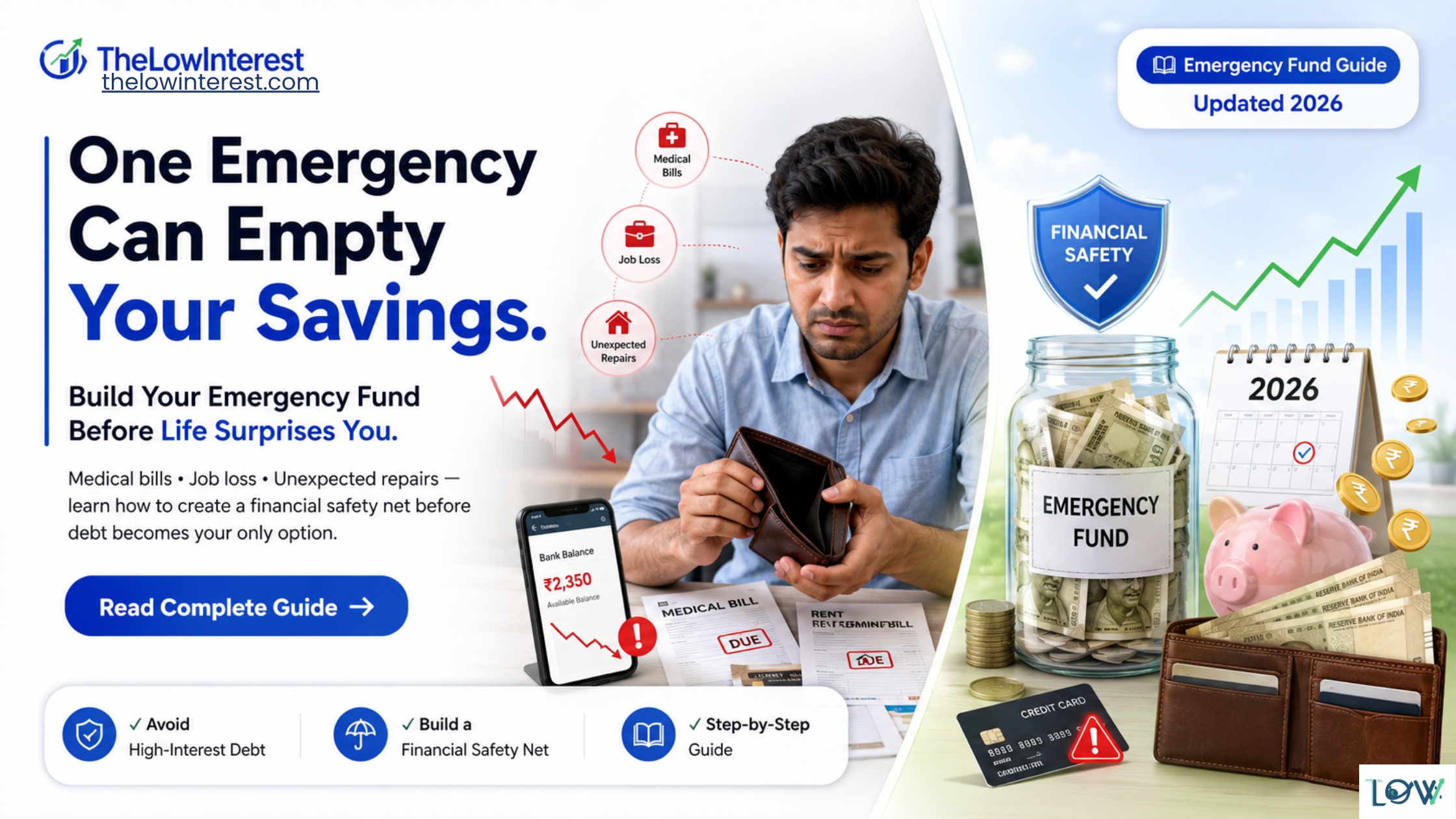
Building an emergency fund in 2026 means setting aside 3 to 6 months of essential expenses in a safe, easily accessible account to cover unexpected events like job loss, medical emergencies, or urgent repairs. Start by calculating your monthly essential expenses, then build a starter goal of one month's expenses before working toward the full target. Keep the money in a savings account or liquid mutual fund rather than stocks or fixed deposits with lock-ins, since accessibility matters more than returns. Automating transfers, redirecting bonuses, and cutting one avoidable expense each month are the fastest ways to reach your goal.
To build an emergency fund in 2026, calculate your monthly essential expenses, set a starter goal of ₹15,000–₹25,000, then save 3–6 months of expenses in a high-interest savings account or liquid mutual fund. Automate a fixed transfer every payday, redirect bonuses and refunds, and avoid touching the fund for non-emergencies.
Most people don't think about an emergency fund until they actually need one — and by then, it's usually too late. A sudden hospital bill, a job loss, a broken laptop right before an exam, or an urgent trip home can throw an entire month's budget into chaos. If you've ever had to borrow money, swipe a credit card you couldn't pay off, or dip into your investments to handle a crisis, you already know why an emergency fund matters.
Learning how to build an emergency fund in 2026 is one of the most practical financial habits you can develop this year, whatever your income level. This guide walks you through exactly how much to save, where to keep the money, and a realistic step-by-step plan to get there — even if you're starting from zero.
You don't need a huge salary to start. You need a plan, a little discipline, and about 30 days to build the habit that makes the rest possible.
What Is an Emergency Fund?
A emergency funds is money set aside specifically for unplanned, urgent expenses — not for vacations, gadgets, or planned purchases. It's meant to sit quietly in a safe, liquid account until you genuinely need it.
Think of it as a financial cushion between you and a crisis. Without one, an unexpected expense often turns into debt. With one, the same expense is just an inconvenience.
A true emergency fund has three defining features:
- Liquid — you can access it within a day or two, without penalties.
- Safe — it isn't exposed to market ups and downs.
- Separate — it's kept apart from your regular spending account so you're not tempted to dip into it.
Did You Know?
Financial planners often distinguish between "emergency savings" and "general savings." General savings can be used for goals like a phone upgrade or a trip. Emergency savings are reserved strictly for genuine, unavoidable expenses.
Why an Emergency Fund Matters More in 2026
Household budgets have been under more pressure in recent years, with rising costs for essentials like rent, groceries, healthcare, and school fees squeezing monthly savings. At the same time, gig work, contract roles, and shorter job tenures have become more common, which means income isn't always as predictable as it used to be for a full-time, permanent role.
This combination — higher costs and less certain income — makes a dedicated emergency fund more important, not less. A cushion of savings gives you room to make calm decisions during a crisis instead of panicked ones, like accepting a bad loan, selling investments at a loss, or maxing out a credit card.
An emergency fund isn't predicting about any disaster. It's about being financially prepared for the ones you can't predict.
Who Needs an Emergency Fund?
Short answer: everyone with regular expenses needs one, but the size and urgency vary by situation.
- Salaried employees — even with a stable job, layoffs, notice-period gaps, or delayed salaries can happen.
- Students — an emergency fund covers sudden costs like a lost phone, urgent travel, or medical visits without depending entirely on parents.
- Freelancers and self-employed professionals — income is often irregular, so a bigger cushion is essential to smooth over slow months.
- Families with dependents — children, aging parents, or a single income household all raise the stakes of an unplanned expense.
- First-time savers and young investors — building this habit early makes every future financial goal easier to protect.
If you rely on your monthly income to cover monthly expenses — which is true for almost everyone — you need an emergency fund.
How Much Should You Save?
This depends on your spending per month still 3 to 6 months of monthly expenses is essential. But the right number for you depends on your income stability and household responsibilities.
Situation | Recommended Emergency Fund |
Dual-income household, both stable jobs | 3 months of expenses |
Single income, stable job | 6 months of expenses |
Freelancer or commission-based income | 6–9 months of expenses |
Single parent or sole earner | 9–12 months of expenses |
Student with limited income | 1–3 months of essential expenses |
Essential expenses include rent or EMI payments, utilities, groceries, insurance premiums, minimum debt payments, and transportation. They do not include discretionary spending like dining out, streaming subscriptions, or shopping — those are the first things you'd cut in a real emergency anyway.
How to Calculate Your Emergency Fund
Calculating your target number is simpler than it sounds. Follow this formula:
Monthly essential expenses × number of months of cover = your emergency fund target
For example, if your essential monthly expenses add up to ₹30,000 and your situation calls for 6 months of cover:
₹30,000 × 6 = ₹1,80,000 emergency fund target
To find your monthly essential expenses, list out:
- Rent or home loan EMI
- Electricity, water, gas, and internet bills
- Groceries and household supplies
- Health and life insurance premiums
- Minimum payments on any existing loans or credit cards
- Transportation and fuel
- School or childcare costs, if applicable
Add these up, and you have your baseline number. This is also the exact figure you'd want to review every 6–12 months, since expenses tend to creep up over time.
Step-by-Step Guide to Building an Emergency Fund
Here's a practical, beginner-friendly path to build your fund without overwhelming your monthly budget.
Step 1: Calculate Your Monthly Essential Expenses
Use the formula above to get your baseline number. Be honest — underestimating your expenses will leave you short when you actually need the fund.
Step 2: Set a Starter Goal
Before chasing the full 3–6 month target, aim for a smaller starter goal of around ₹15,000–₹25,000, or one month's essential expenses, whichever is achievable first. This covers most minor emergencies and builds momentum quickly.
Step 3: Open a Dedicated Savings Account
Keep your regular spending account and your emergency reserve apart. A sweep-in fixed deposit connected to your account or a specialized high-interest savings account work effectively since they conceal the funds without totally locking them away.
Step 4: Automate a Fixed Monthly Transfer
Set up an automatic transfer on salary day — even ₹1,000–₹2,000 a month adds up over a year. Automation removes the willpower problem entirely; the money moves before you get a chance to spend it.
Step 5: Direct Windfalls Straight to Your Fund
Bonuses, tax refunds, cashback, gifts, or freelance side income are ideal for accelerating your fund without touching your regular budget.
Step 6: Cut One Avoidable Expense Each Month
Pick one non-essential expense — an unused subscription, a food delivery habit, impulse online shopping — and redirect that amount to your emergency fund until the habit becomes automatic.
Step 7: Increase Contributions as Income Grows
Every raise, bonus, or new income stream should send a portion — even 10–20% — toward your emergency fund until it's fully built.
Step 8: Review and Rebuild After Use
If you ever use the fund, treat rebuilding it as your top financial priority before resuming other savings goals.
Pro Tip: Name your savings account something specific, like "Emergency Fund — Do Not Touch." A small psychological nudge like this genuinely reduces the temptation to dip into it for non-emergencies.
Where Should You Keep Your Emergency Savings?
Your emergency fund needs to be accessible within a day or two, so avoid anything with a lock-in period or market risk. The best options are:
- Savings account — instant access, no lock-in, ideal for the portion you might need immediately.
- Liquid mutual funds — slightly better returns than a savings account, with redemption usually processed within 1–2 working days.
- Sweep-in / auto-FD linked to savings account — earns FD-level interest but automatically converts back to cash when your balance runs low.
Avoid keeping emergency savings in stocks, cryptocurrency, long-term fixed deposits, or real estate. These may offer better returns, but the goal of an emergency fund is preservation and instant access — not growth.
Savings Account vs Liquid Fund vs Fixed Deposit
Feature | Savings Account | Liquid Mutual Fund | Fixed Deposit |
Access speed | Instant | 1–2 working days | Premature withdrawal penalty |
Risk level | Very low | Low | Very low |
Typical returns | Low | Moderate | Moderate |
Best for | Immediate-access portion | Slightly larger cushion | Not recommended for full fund |
Lock-in | None | None | Yes (unless sweep-in) |
A practical approach many financial planners suggest: keep one month's expenses in your savings account for instant access, and the rest in a liquid fund or sweep-in FD for slightly better returns without sacrificing accessibility.
Common Mistakes to Avoid
- Treating it as a savings goal, not a safety net. Using the fund for a sale or a planned purchase defeats its purpose.
- You keeping it in same account which is used for daily spending This makes accidental spending almost inevitable.
- Chasing high returns. An emergency fund isn't an investment — growth is secondary to accessibility.
- Setting an unrealistic target and giving up. Starting with ₹15,000 is far better than waiting until you can save ₹2,00,000 at once.
- Forgetting to rebuild it after use. Many people use their fund once and never replenish it, leaving themselves exposed again.
- Not automating contributions. Manual transfers are easy to skip during a busy or tight month.
Emergency Fund vs Investment
These serve completely different purposes, and confusing them is one of the most common financial planning mistakes.
An emergency fund exists to protect you from short-term shocks — it prioritizes safety and access over returns. An investment, on the other hand, exists to grow your wealth over time and typically involves market risk and a longer time horizon.
The right order is usually: build your starter emergency fund first, then begin investing, then continue growing your emergency fund toward the full 3–6 month target alongside your investments. Skipping the emergency fund to invest more aggressively often backfires — a market downturn combined with a sudden expense can force you to sell investments at a loss.
Emergency Fund vs Insurance
An emergency fund and insurance work together, not as substitutes for each other.
Insurance (health, life, or income protection) covers large, specific risks — a major surgery, an accident, or loss of the family's primary earner. An emergency fund covers smaller, more frequent, more unpredictable expenses — a deductible, a short income gap, an urgent repair — that insurance doesn't cover or that fall below your policy's threshold.
Relying on insurance alone leaves gaps: waiting periods, claim processing time, deductibles, and expenses insurance simply doesn't cover. Your emergency fund fills exactly those gaps.
Real-Life Examples
Example 1 — Salaried employee in Pune: Riya, a 27-year-old marketing executive, kept ₹90,000 in a liquid fund as her emergency cushion. When her company had a two-month delay in a project-linked bonus payout that she had budgeted for, she covered the gap from her fund instead of using a credit card, avoiding any interest charges.
Example 2 — Freelance graphic designer in Bengaluru: Arjun's income varies month to month. He keeps 8 months of expenses in his emergency fund, split between a savings account and a liquid fund. During a slow quarter with fewer client projects, this cushion let him cover rent and essentials without taking on debt or underpricing his next project out of desperation.
Example 3 — Young family in Jaipur: When their child needed an unplanned hospital visit, Meera and her husband used ₹35,000 from their emergency fund to cover costs not reimbursed by insurance. Because the fund already existed, the family didn't have to borrow from relatives or use a personal loan.
Expert Tips
- Automate before you budget the rest. Treat your emergency fund contribution like a fixed bill, not a leftover amount.
- Round up your target realistically. If your calculation comes to ₹1,72,000, round up to ₹1,75,000 — a small buffer helps.
- Review annually. As your expenses rise, your emergency fund target should rise with them.
- Separate "wants" from "needs" honestly when calculating essential expenses — this keeps your target realistic and achievable.
- Don't wait for a lump sum. Small, consistent contributions build the fund faster than waiting for a large bonus that may not come.
2026 Trends Affecting Emergency Savings
A few shifts are shaping how people are approaching emergency savings this year:
- Rising cost of living across housing, healthcare, and everyday essentials means the same "3–6 months" target now requires a larger rupee amount than it did a few years ago.
- More freelance and gig income is pushing more people toward the higher end of the recommended savings range (6–9 months) rather than the standard 3 months.
- Wider adoption of liquid funds and sweep-in accounts among first-time savers, as more people look for slightly better returns without sacrificing accessibility.
- Growing awareness through financial literacy initiatives, including efforts by regulators like the Reserve Bank of India (RBI) and the Securities and Exchange Board of India (SEBI), which continue to encourage disciplined saving and informed financial decisions among the public.
- Increased use of automated savings tools built into banking apps, making it easier than ever to set up recurring transfers without manual effort.
30-Day Emergency Fund Action Plan
Day | Action |
Day 1–2 | Calculate your monthly essential expenses |
Day 3 | Set your starter goal and full target amount |
Day 4–5 | Open a dedicated savings account or liquid fund |
Day 6–7 | Set up an automated weekly or monthly transfer |
Day 8–14 | Track spending and identify one expense to cut |
Day 15 | Redirect the cut expense into your fund |
Day 16–25 | Continue automated contributions; add any windfalls |
Day 26–29 | Review progress against your starter goal |
Day 30 | Reassess and set your next milestone toward the full target |
Emergency Fund Checklist
- Calculated monthly essential expenses
- Set a starter goal (₹15,000–₹25,000 or 1 month's expenses)
- Opened a separate, dedicated account
- Automated a recurring transfer
- Identified one expense to redirect into savings
- Set a full target (3–12 months, based on your situation)
- Reviewed the fund's location (savings account vs liquid fund)
- Set a reminder to review the target every 6–12 months
- Agreed on what counts as a genuine "emergency"
- Planned to rebuild the fund immediately after any use
Key Takeaways
- An emergency fund covers 3–6 months of essential expenses, with freelancers and single-income households needing more
- Start small — a ₹15,000–₹25,000 starter goal builds momentum faster than an intimidating full target.
- Keep the fund liquid and separate, in a savings account or liquid mutual fund — not in investments.
- Automate contributions so the habit doesn't depend on willpower.
- An emergency fund and insurance work together; neither replaces the other.
- Review and rebuild your fund regularly as expenses and income change.
Frequently Asked Questions
1. What is an emergency fund?
An emergency fund is money set aside specifically for unexpected expenses like medical bills, job loss, or urgent repairs. It's kept separate from regular spending and stays in a safe, easily accessible account rather than investments.
2. How much emergency fund should I have in 2026?
Most financial planners recommend 3–6 months of essential expenses. Freelancers, single-income households, and those in unstable industries should aim for 6–12 months to account for greater income uncertainty.
3. Where should I keep my emergency fund?
Keep it in a high-interest savings account, a liquid mutual fund, or a sweep-in fixed deposit. These options offer quick access without market risk, unlike stocks or long-term fixed deposits.
4. Should I pay off debt or build an emergency fund first?
Build a small starter fund (around ₹15,000–₹25,000) first, then focus on paying off high-interest debt, then return to building your full 3–6 month emergency fund once debt is under control.
5. How do I calculate my emergency fund target?
Multiply your monthly essential expenses by the number of months of cover you need (typically 3–6). For example, ₹30,000 in expenses × 6 months = ₹1,80,000 target.
6. Is 3 months enough, or do I need 6?
Three months is generally sufficient for dual-income, stable households. Six months or more is safer for single-income earners, freelancers, or anyone with less predictable income
Conclusion
Learning how to build an emergency fund in 2026 isn't about finding a large amount of money all at once — it's about starting small, automating consistently, and protecting that fund from everyday temptations. Whether you're a salaried employee, a student, a freelancer, or supporting a family, the same core steps apply: calculate your essential expenses, set a realistic starter goal, keep money separate and accessible and to build steadily.
The families and individuals who handle financial shocks with the least stress are rarely the ones with the highest income — they're the ones who built a cushion before they needed it. Start this week, even with a small amount, and let automation do the rest. - Thelowinterest


.png)