By Low Intrest Loans
24 Nov, 2026
Finance Influencer Guidelines India 2026: SEBI, ASCI Rules
Short answer: The finance influencer guidelines in India come from three regulators. SEBI says you can teach about money but shouldn't give investment advice or promise returns without registration. ASCI says every paid post needs a clear label, and finance creators must show their qualifications upfront. The CCPA can fine you up to ₹10 lakh for a misleading endorsement. Teach, label, and never promise an outcome.
Making finance content and want brand deals that follow these rules? Apply to collaborate with Fintech Poonam.
Key facts at a glance
| Rule | What it says | Source and date |
|---|
| Investor education | Allowed, as long as it doesn't amount to advice or return claims | SEBI, October 2024 circular and January 2025 update |
| Brand ties | Regulated entities can't associate with unregistered people who give advice or claim returns | SEBI, October 2024 |
| Registration on social media | Regulated entities and their agents must show their registered name and number | SEBI circular, 26 February 2026, effective 1 May 2026 |
| Ad labels | Clear label on each paid post, not just in your bio | ASCI influencer guidelines |
| Short video labels | At least 3 seconds on screen for videos up to 15 seconds | ASCI influencer guidelines |
| Penalties | Up to ₹10 lakh, and up to ₹50 lakh for repeat violations | CCPA guidelines, 2022 |
What are the finance influencer guidelines in India?
They are a set of rules from three bodies that together decide what a finance creator can say and how a paid post must be labelled. They aren't one law. SEBI looks at advice, ASCI at advertising, and the CCPA at misleading endorsements.

| Body | Its job | What it means for you |
|---|
| SEBI | Regulates the securities market | Educate, don't recommend securities or promise returns |
| ASCI | Sets advertising standards | Label every paid post and show finance credentials |
| CCPA | Protects consumers from misleading ads | Disclose any paid link and don't mislead |
Here's why this matters in practice. A brand's lawyer reads all three before approving you. Get them right and you look like a safe partner. Get them wrong and the deal quietly disappears.
What does SEBI let finfluencers say?
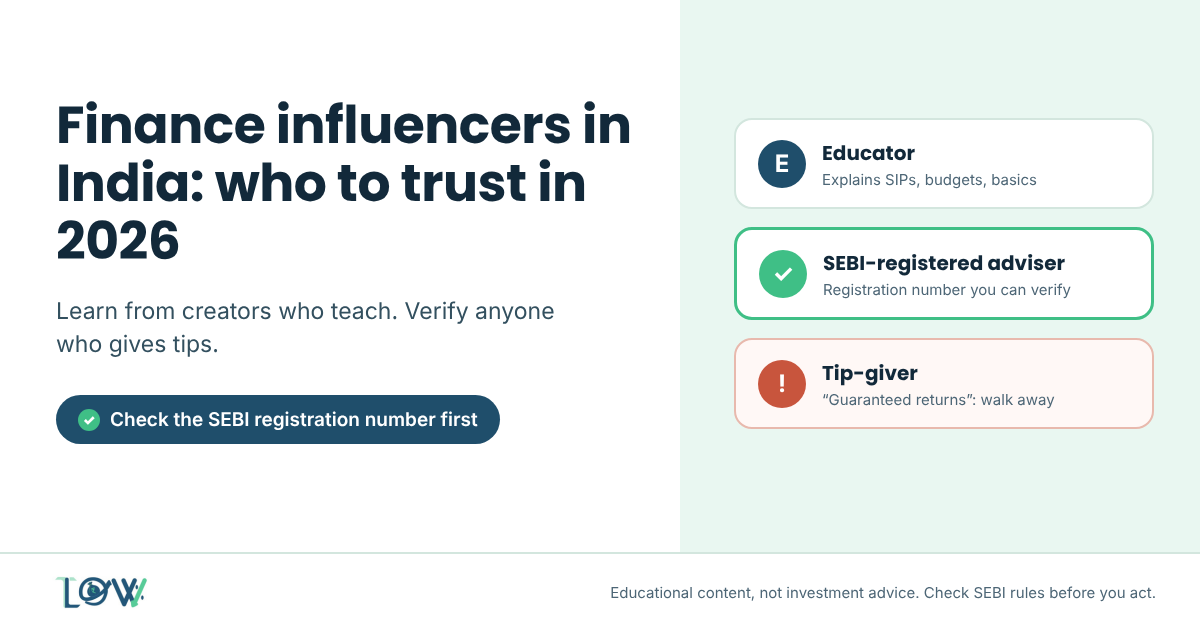
SEBI lets finance creators run investor education. It doesn't let unregistered creators give investment advice, buy or sell calls or return claims. SEBI also stops regulated brands from working with creators who do.
What's a finfluencer? A finance influencer: someone who creates money, investing or banking content on social media.
Education vs advice: the line that matters
| Usually fine (education) | Risky (advice or return claims) |
|---|
| How a SIP works | "Buy this stock today" |
| What an index fund is | Target prices and buy or sell calls |
| How to read a mutual fund factsheet | "This fund will give you 15% every year" |
| Risks, fees and taxes explained | Asking viewers to copy your trades |
A quick test: if your video would make a viewer buy one specific security tomorrow, it's advice, not education.
Why brands care: the association rule
Since October 2024, SEBI-regulated entities such as brokers, mutual funds and advisers can't associate with unregistered people who give advice or make return claims. That covers money and other benefits, including referral fees, free access and shared leads. So if your channel gives tips, a broker may say no, or end a deal later.
Live market data
A January 2025 SEBI update tightened how live stock data can be used in educational content. If you teach with charts, use past examples and check the current circular.
The 2026 social media disclosure rule
SEBI's circular of 26 February 2026 took effect on 1 May 2026. It requires SEBI-regulated entities and their agents, such as stock brokers, advisers and mutual fund distributors, to show their registered name and number on the home page of their social media handles and at the start of securities-related content. The full text is on the SEBI circular page.
This rule is aimed at registered people. If you're a pure educator, it isn't your direct duty, but it tells you where the regulator is heading: toward making registered and unregistered voices easy to tell apart.
What does ASCI require from finance influencers?
ASCI requires a clear disclosure label on every paid or affiliate post. For finance, it also expects creators to show their qualifications upfront, and it says investment-related advice should only come from SEBI-registered people.
- Label every post. Use clear labels such as #ad, Sponsored, Collaboration or Partnership.
- Put it upfront. Don't bury it in a pile of hashtags.
- Don't rely on your bio. A line in your profile isn't enough.
- Mind the timing. For videos up to 15 seconds, the label should stay on screen for at least 3 seconds. Longer videos have longer requirements.
- Show your credentials. For advice beyond investing, ASCI expects relevant qualifications, such as an IRDAI licence or a chartered accountant qualification. Show them on screen or say them in your opening line.
- Check the claims. Ask the brand for proof behind every number you say, and keep it on file.
What can the CCPA fine you for?
The CCPA can fine endorsers for misleading advertisements. Its 2022 guidelines say your endorsement should reflect your honest opinion, and any material connection with the brand must be disclosed. The penalty is up to ₹10 lakh, and up to ₹50 lakh for repeat violations. The authority can also stop an endorser from endorsing for a period.
"The brand wrote the script" isn't a defence. You're responsible for what you say.
Want brand collaborations that already have compliant scripts and approved claims?
Share your channel with our team and choose "Brand Collaboration" on the enquiry form.
What can you say in a sponsored finance post?
You can describe how a product works and what to check before buying. You can't promise outcomes. If a sentence guarantees a result, rewrite it as a process or a condition.
| Product | Safer wording | Avoid |
|---|
| Mutual funds and SIPs | "A SIP invests a fixed amount every month. Returns depend on the market and aren't guaranteed." | "This fund will double your money." |
| Personal loans | "Interest rate and eligibility depend on your profile and the lender." | "Guaranteed approval." "No documents needed." |
| Credit cards | "Compare fees, rewards and interest before you apply." | "Free money." "Best card for everyone." |
| Insurance | "Check what's covered, the waiting periods and the exclusions." | "Claims are always approved." |
| Accounting and GST tools | "Try the free plan and see if it fits your invoicing." | "File GST in two minutes, zero mistakes." |
Your pre-publish checklist
- Is this education or advice? Remove any buy or sell call.
- Is there a clear ad label at the start, and does it stay on screen long enough?
- Did I mention the paid or affiliate link in the video, not only the description?
- If I give financial advice, have I shown the qualification or registration required?
- Do I have proof for every number I quote?
- Is there a short risk line on investing, loan and insurance content?
- Have I removed "guaranteed", "assured" and "risk-free"?
- Have I disclosed free gifts and commissions too?
- Did the brand give me approved claims in writing?
- Did I save the script and brief?
New to finance content? Sharpen your explainers first with our free personal finance course.
What should a brand contract say about compliance?
It should list the approved claims, say who is responsible for their accuracy, state the exact disclosure wording, confirm that the brand is allowed to work with you (especially a SEBI-regulated one), and let you refuse a script that breaks the rules. Add a takedown process in case a rule changes after you post.
Common mistakes
- Calling a stock pick "educational"
- Relying on a bio line instead of labelling each post
- Hiding "#ad" in a block of hashtags
- Using a CA or MBA title to justify investment tips
- Repeating a brand's claim without proof
- Forgetting that affiliate links need disclosure too
- Leaving old videos unchanged after the rules move
About The Low Interest
The Low Interest is a Pune-based platform that helps people compare personal loans, credit cards and insurance and check their credit score. Our education channel, Fintech Poonam, explains money in simple language. Learn more on our About Us page.
Ready to work with a brand that gets compliance?
You've got the rules. Now put them to work. Tell us about your channel, your audience and the kind of finance content you make, and our team will get back to you.
Apply to collaborate with Fintech Poonam
Frequently asked questions
What are the finance influencer guidelines in India?
They are rules from SEBI, ASCI and the CCPA. SEBI covers investment advice and return claims, ASCI covers ad labels and qualifications, and the CCPA covers misleading endorsements. You can teach, but you shouldn't give stock tips, promise returns or hide paid promotions.
Do I need SEBI registration to make finance content?
General investor education has been treated as allowed. Giving investment advice or recommending specific securities is where registration comes in. If you're unsure, ask a qualified professional.
Can finfluencers give stock tips?
Unregistered creators shouldn't give stock tips, buy or sell calls or return claims. SEBI also restricts regulated brands from associating with people who do.
Do I have to disclose affiliate links?
Yes. ASCI treats any material connection, including commissions and free products, as something to disclose, and the label belongs on the post itself.
How long must the ad label stay on screen?
For videos of up to 15 seconds, at least 3 seconds. Longer videos have longer requirements, so check the current ASCI guidelines.
What is the penalty for a misleading endorsement?
The CCPA can fine an endorser up to ₹10 lakh, and up to ₹50 lakh for repeat violations.
Can brokers pay unregistered creators?
SEBI restricts regulated entities from associating with unregistered people who give advice or make return claims, including through non-monetary benefits. Brokers are therefore careful.
Sources checked
SEBI circular dated 26 February 2026 (social media disclosure); SEBI circulars of October 2024 and January 2025 (association and educational content); ASCI Guidelines for Influencer Advertising and its health and finance addendum; CCPA Guidelines for Prevention of Misleading Advertisements and Endorsements, 2022.
Disclaimer: This article is for education only and isn't legal, financial or tax advice. Rules change, so check the latest SEBI, ASCI and CCPA guidance or speak to a qualified professional before you publish.